Page 2 :
Author, Alphonse Daudet is considered to be one it, most iconic names of French literature. Unlike, , famous, , many, , writers in world, , history, Alphonse, wasn't very well, , he, , educated;, wrote, , his, , first, , novel at the age, of fourteen. His, works drew inspiration from instances of his, life., , His works Trente and de Paris' and, , 'Souvenirs dun home de letters' seemed to be, more like autobiographies. Passed away in the, final, , decade,, , his, , name, , is, , very, , popular, , amongst the citizens of France. A lot of, educational institutions in France have been, named after this famous writer. Alphonse is, one of the handful writers who portray human, emotions in a very realistic manner.
Page 3 :
The Last Lesson : About the Author, Alphonse Daudet was a French novelist and, , playwright and was a part of the French Naturalism, movement. He started his career as a school teacherr, , but, , quickly got tired of the vocation. Soon, he gave up, teaching and decided to go to Paris to become a, journalist. There, he was hired by Le Figaro and, wrote some plays which made him popular in the, literary circles. He was later hired as a private, , secretary by the Duke of Morny, a powerful minister, of Napoleon III., Daudet later published Lettre de mon Moulin which, , gained him a, , sizable readership. He produced works, , like Le Petit Chose, L'Arlésienne and Aventures, , Prodigieuses de Tartarin de Tarascon among others., However, it was Fromont jeune et Risler aîné which, turned out to be his masterpiece. Daudet died of, , syphilis on 16th December 1897.
Page 4 :
SETTING, A village in, , Alsace,, Prussian, occupied, France
Page 5 :
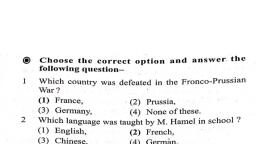
The Last Lesson by Alphonse Daudet is set, in the days of the Franco-Prussian war in, , which France was defeated by Prussia led, , by Bismark. The French districts of Alsace, and Lorraine passed into Prussian hands., The two protagonists of the story, M., Hamel and Franz, are from Alsace. M., Hamel is a French teacher and Franz is one, , of his students. The story revolves around, how the, , lives., , war, , plays, , a, , pivotal, , role in their
Page 6 :
THEMES, Language, , .ldentity, ., , Patriotism, , Education, , Linguistic Chauvinism, .War
Page 7 :
Theme, Dominant Theme raised in the text: linguistic, chauvinism, "Chauvinism" is a devotion for or against, , something, just based on what you feel (not, , necessarily, , what, , you, , may, , know)., , So,, So, , Linguistic chauvinism is the idea that one's, language is superior to that of others. This, happens generally when the language is that, of the ruling class.
Page 8 :
Linguistic chauvinism refers to the imposition, of one language on others., , Language, , is, , considered to be the cultural identity of the, people who use it. The language is the pride of, the country as it defines the cultural, The Last Lesson raises the, , history., , burning question, , very innocently through the words of little, Franz that "Will they make them sing in, German, even the pigeons?" This raises the, , question, , of, , imposing, , a, , language, , on, , others., , The child questions that when even the birds, and animals can't be forced to abandon their, , language,, , then what forces, , a language on others., , a man, , to enforce
Page 9 :
The, , Last, , Lesson, , language and, , its, , revolves, , around, , importance to the, , the, , citizens of, , a country. It is the duty of every citizen to, , safeguard the language of the country as it is, the, , identity of that country. The, , lesson, , depicts, , how after defeating France in the war, the, Prussians wanted to rule over not only the, , territory of, , France but also, , over, , the minds and, , hearts of the people. The story reinforces the, fact that we value something more when it is, lost. The pain and anguish of the students and, the teacher is evident as everyone realizes, how things were taken for granted. The lesson, emphasizes the importance of the mother, tongue for everyone and the need to realize, , the fact that it is our language which gives us, our identity, respect and freedom.
Page 10 :
CHARACTERS, Little Franz, Mr Hamel, , (the, , French teacher), , Villagers
Page 11 :
9. M. Hamel as a teacher., , ) had been teaching for forty years without, , wavering., (i), , refused to give up, , on, , the last, , day, , of, , teaching-treated it as the most important day, was in his best fineries-had prepare copies for, , the, , children, , in, , which, , he, , had, , written, , beautifully-was ready to teach all age groups, without reservation-decided to be patient and, , impart whatever he could, , even, , if it, , was, , the, , last day-stood tall to bid and accept farewel., (ii) imparted knowledge about the importance, of the mother tongue., , (iv), , instilled, , patriotism amongst his students, , with his wise words.
Page 12 :
M. Hamel made the Class realize they were, reluctant to learn, postponed learning, parents sent them to work, himself sent students to water his plants., all to blame for the situation, too late to make amendments, , no time to make up for lost time, Germans would laugh at their inability to speak French, Main Characters, 1. M. Hamel, , sincere French teacher, teaching French for the last 40 years., knows subject very well, passionate about French, considers French - clearest, most beautiful and logical language., , feels language as a key to guard oneself., proud of being French, , upset by occupation of Alsace by Germans, attached to town, School & People., , particular about discipline and learning, last day made students to exercise on all aspects of language., , blamed himselffor being selfish., emotional, could not utter a word at the end of the class, 2. Franz, sensitive, honest, blames himself for ignoring lessons, , feels greatly embarrased after the announcement by M. Hamel, about the lesson being the last lesson, filled with a deep sense of regret., pays the utmost attention to every word
Page 17 :
thought to myself, "will they, make them sing in German,, I, , even the pigeons?", , These seemingly harmless lines present, , a, , sharp, , critique of the linguistic chauvinism of the Prussians, and the repressive nature of the Prussian regime. It, also hints at the limits beyond which they will never, be able to assert their brute force., , The literary device of contrast is employed at the, end of the lesson when the striking of the church, clock is followed by the recital of the Angelus, a, Catholic prayer. Simultaneously, the Prussians sound, their trumpet and the two contrasting worlds of, peace and violence, faith and force meet at a brief, moment in time. And it is in this moment that the last, lesson comes to an end.
Page 18 :
...because when a people are, , enslaved, as long as they hold, fast to their language it is as if, they had the key to their prison., , He then begins the grammar lesson. Franz, understands it all. It seems that earlier, he hadn't, listened so carefully and M. Hamel hadn't taught as, , patiently as he did in his last lesson. The grammar is, followed by the writing lesson. Everybody gets down, , writing and the class is filled with a pin drop silence., Once, some beetles fly in but nobody pays attention, to them, not even the little kids. The cooing of the, , pigeons, , on, , the roof makes Franz wonder whether, , the Germans will make the birds sing in German as, well.
Page 19 :
Fancy! For forty years he had, been there in the same place, with his garden outside the, window and his class in front, , of, , him, just like that... ..How it, must have broken his heart to, leave it all, poor man, , M. Hamel's individuality isn't taken into, , consideration when he is, , displaced. He is just, , another agent of the French Language that must be, replaced with one of the German Language. This is, what war effectively does to people. Wars do not, , recognize the humanity of the individual, whether it, be a soldier on the battlefield ground or a teacher in, the classroom. Note that M. Hamel wasn't just a, teacher but also a politically dangerous element in, the eyes of the Prussian regime. His eviction is not, only a linguistic change but careful political decision.
Page 20 :
Now those fellows out there, will have the right to say to, you, How is it you pretend to, be Frenchmen, and yet you can, neither speak nor write your, own language?", , The theme of uncertainty is seen in the first, paragraph of the story through the eyes of the, narrator when he learns the inconvenient fact that it, is M. Hanmel's Last Lesson. Also, the lines, , spoken by, , M. Hamel "she (Alsace) puts off learning till, tomorrow" shows the mistake of not recognizing the, presence of uncertainty in our lives and taking the, present for granted., , Finally, the fact that M. Hamel is being evicted from, the place after forty years of service to the very place, brings forth the theme of displacement. His, emotional suffering is dealt with in most empathic, terms:
Page 21 :
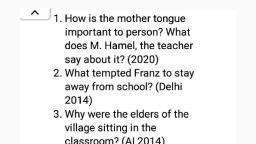
What had the narrator counted on to enter the, school, unnoticed? (Delhi 2010), Answer:, , The narrator (Franz) had counted on the hustle and, bustle that was usual when the school began in order, , to enter there unnoticed. He had thought he could, , depend, , on, , the commotion to get to his desk without, , anybody noticing that he was late for the class., Question 3., , This is your last French lesson" How did Franz react, , to this declaration of M.Hamel? (Delhi 2010), , Answer, When M.Hamel declared that it was their last French, lesson a grim realisation dawned on Franz that he, had so much more yet to learn. He felt sorry for, , whiling away his time and skipping his lessons., , Now, , he did not want to part with his books, which he had, earlier consi-dered a nuisance. He was also deeply, pained at the thought that M.Hamel was leaving.
Page 22 :
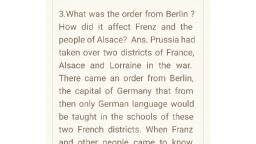
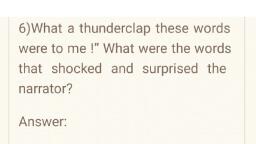
wnat a thunder, , clap these words were to me, , Which were the words that shocked and surprised, little Franz?, , (Delhi 2010), , Answer, When M.Hamel mounted on the chair and, announced that he was there to teach his last French, , lesson that day, Franz was shocked and surprised, He felt very guilty for deliberately ignoring to learn his, native language and he suddenly developed a strange, fascination for his language and his school., , Question 5., , What, , changes came over little, , Franz after he heard, , M.Hamel's announcement? (All India 2010), , Answer, When M.Hamel announced that this, , last French class, , a, , grim, , was, , to be their, , realisation dawned, , on, , Franz, , hardly write his language and now he, to learn it. He, was being deprived of the opportunity, and escaping, felt very guilty of neglecting his classes, M. Hamnel,, school. The thought of losing his teacher,, that he could, , also pained him.
Page 23 :
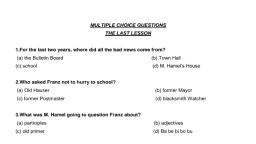
Wnat was tempting Franz to keep away from school, , That morning'? (Comptt. Delhi 2010), Answer., Franz was very late for school that morning. M., Hamel was to question the students on participles, , and Franz knew nothing and feared a scolding. The, bright weather, woods, fields and chirping of birds, tempted him to spend the day outdoors., Question 7., , What was unusual about M. Hamel's dress and, , behaviour on the day of his last French lesson?, (Comptt. Delhi 2010), , Answer, On the day of his last French lesson M. Hamel was, unexpectantly kind. He had put on his beautiful green, , coat, frilled shirt and an embroidered black silk cap, that he, , normally wore only on inspection and prize, , days. In his last lesson he explains everything with, unusual patience as if he wants to teach them, , everything he has ever learned in their last French, , class.