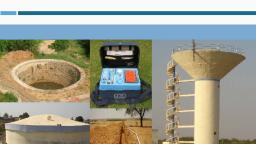
Page 1 : RURAL WATER SUPPLY, &, , SANITATION, Prof. Radhakrishnan K. M.Sc., M.Phil., Ph.D., Department of Civil Engineering, , 16/02/2022, , RURAL WATER SUPPLY & SANITATION, BY PROF. RADHAKRISHNAN K., ,
[email protected], , 1
Page 2 : ➢Understand importance of water, drinking water, standards, water treatment methods and different, types of rural water supply systems., Rural water supply:, ❖ Introduction, ❖ Need for a protected water supply, ❖ Investigation & selection of water sources, ❖ Various types & techniques of rural water supply systems, ❖ Protection of well waters, ❖ Drinking water quality standards, ❖ Water treatment methods, ➢ Disinfection, ➢ Defluorination, ➢ Removal of Hardness & Iron, ➢ ground water contamination & control, 1. Identify, , 16/02/2022, , i) problems in rural water supply, ii) monitor quality & maintenance of rural water supply, iii) design low-cost water treatment system for rural areas., RURAL WATER SUPPLY & SANITATION, BY PROF. RADHAKRISHNAN K., ,
[email protected], , 2
Page 3 : Typical rural water supply system, , Zone-1, Higher Elev., , Zone-2, Lower Elev., , 16/02/2022, , RURAL WATER SUPPLY & SANITATION, BY PROF. RADHAKRISHNAN K., ,
[email protected], , 3
Page 7 : Route march: Struggle for existence, , 16/02/2022, , RURAL WATER SUPPLY & SANITATION, BY PROF. RADHAKRISHNAN K., ,
[email protected], , 7
Page 8 : Mumbai, , 74%Mumbai, of Indian live in 6,38,365 villages (2001 censes), Dehli, , More than 1,00,000 villages do not have safe, drinking water source in our country, About 22.5 crore people are not accessible to safe drinking water, Chennai, In 4,500, villages, GW, is, not, fit, for, drinking, purpose, Hyderabad, , 16/02/2022, , RURAL WATER SUPPLY & SANITATION, BY PROF. RADHAKRISHNAN K., ,
[email protected], , 8
Page 10 : India census: Half of homes have phones but no toilets, , Only 46.9% of the 246.6 million households have lavatories, while 49.8% (62 crore) defecate in the open., The remaining 3.2% use public toilets., 3,00,000 Children: affected by water borne diseases, 16/02/2022, , RURAL WATER SUPPLY & SANITATION, BY PROF. RADHAKRISHNAN K., ,
[email protected], , 10
Page 12 : Valuing water sources –, natural water resources, and ecosystems, , Higher value must be given to protect the, environment to ensure a good quality water, supply & build resilience flood and drought., 16/02/2022, , RURAL WATER SUPPLY & SANITATION, BY PROF. RADHAKRISHNAN K., ,
[email protected], , 12
Page 13 : 2. Valuing water infrastructure, , 4. Valuing water as an input to production, and socio-economic activity, , 5. Valuing socio-cultural, aspects of water, , 3. Valuing water services, 16/02/2022, , RURAL WATER SUPPLY & SANITATION, BY PROF. RADHAKRISHNAN K., ,
[email protected], , 13
Page 14 : Water ATM?, , 16/02/2022, , Is it a solution?, , RURAL WATER SUPPLY & SANITATION, BY PROF. RADHAKRISHNAN K., ,
[email protected], , 14
Page 15 : Water means, different things to different people, In households, schools and workplaces, water can mean, health, hygiene, dignity and productivity., In cultural, religious and spiritual places, water can mean a, connection with creation, community and oneself., , In natural spaces, water can mean peace, harmony and, preservation., , 16/02/2022, , RURAL WATER SUPPLY & SANITATION, BY PROF. RADHAKRISHNAN K., ,
[email protected], , 15
Page 16 : Water Resources Management- Challenges/Issues in the Country, varied and complex and could be categorized as follows:, •Natural situation (Tropical Monsoon climate), –large scale spatial & temporal variation / recurring droughts & frequent floods., •Human, Managerial & Developmental challenges, – Increasing water demand & falling per capita availability, - water use and energy efficiency, - deterioration of water quality, - reduction or deterioration of available resources (loss of surface storage), - increasing competition/conflict within sectors, - under & inefficient utilization of irrigation potential, - over exploitation & depletion of ground water resources, - water-logging & soil salinity in irrigated lands, - fragmentation of management of water/ management of shared resources, - lack of spatial inventory for large number of water infrastructure in the country, - outdated water resources potential estimates, - significant change in land use / land cover, - demographic and utilization pattern in past few decades., •Climate change impact, –Addressing the impact of climate change on water availability and economy, 16/02/2022, , RURAL WATER SUPPLY & SANITATION, BY PROF. RADHAKRISHNAN K., ,
[email protected], , 16
Page 17 : Water Management options, •Conservation, •conjunctive use, •consumptive use, •natural recharge, •artificial recharge, •Rainwater Harvesting, 16/02/2022, , RURAL WATER SUPPLY & SANITATION, BY PROF. RADHAKRISHNAN K., ,
[email protected], , 17
Page 18 : How we manage the water supply?, , 16/02/2022, , RURAL WATER SUPPLY & SANITATION, BY PROF. RADHAKRISHNAN K., ,
[email protected], , 18
Page 19 : ✓The supply of water to rural areas may be more important than that, of urban areas since approximately 66 % of the world's population live, in rural areas., ✓In order to effectively supply water to rural areas, the engineer, must take into account various factors that may not be relevant in, , urban areas., , 16/02/2022, , RURAL WATER SUPPLY & SANITATION, BY PROF. RADHAKRISHNAN K., ,
[email protected], , 19
Page 20 : ✓These, , factors include the lack of infrastructural facilities,, , population distribution, needs of the rural communities etc., ✓An engineer planning rural water supplies should also seek the help, , of various professionals including the hydrologist, meteorologist,, , health workers, demographers and sociologist., ✓Before implementing the rural water supply scheme, the planner, , should establish the needs of the community. This objective can be, accomplished through active community participation., , 16/02/2022, , RURAL WATER SUPPLY & SANITATION, BY PROF. RADHAKRISHNAN K., ,
[email protected], , 20
Page 21 : ✓Three key elements to ensure the cost effectiveness, , of water supply and sanitation projects:, i., , Involvement of the community in all aspects of the, , project;, ii. The use of appropriate technology;, iii. Training activities in conjunction with the project;, , 16/02/2022, , RURAL WATER SUPPLY & SANITATION, BY PROF. RADHAKRISHNAN K., ,
[email protected], , 21
Page 24 : Jala Saksharatha (Education), , • Preparing a budget for our daily consumption of water- use of, , water for bathing, toilet, washing clothes and utensils, cooking,, mouth washing etc. This is the beginning of Jala Saksharatha, , ▪ Knowledge of water sources in and around us, pollution, misuse, , Jala Jagriti (Awareness), • create awareness among the public about greening,, rainwater harvesting, etc., , .Jala Samrakshan (Conservation)., Implementation of appropriate water conservation methods at suitable places, 16/02/2022, , RURAL WATER SUPPLY & SANITATION, BY PROF. RADHAKRISHNAN K., ,
[email protected], , 24
Page 28 : Rajendra Singh water conservationist from Alwar district, Rajasthan, , Known as "waterman of India", he won the Stockholm Water Prize, an, award known as "the Nobel Prize for water", in 2015, , 16/02/2022, , RURAL WATER SUPPLY & SANITATION, BY PROF. RADHAKRISHNAN K., ,
[email protected], , 28
Page 29 : Starting from a single village, in 1985, over the years he, helped, build over 11,000 johads and, other water conservation, structures to collect, rainwater for the dry, seasons,, has brought water back to, over 1,000 villages, revived five rivers in, Rajasthan, Arvari, Ruparel,, Sarsa, Bhagani and Jahajwali., The Guardian named him, amongst its list of "50 people, who could save the planet"., 16/02/2022, , RURAL WATER SUPPLY & SANITATION, BY PROF. RADHAKRISHNAN K., ,
[email protected], , 29
Page 33 : Sanitation:, ➢Sanitation is related to, , the supply of clean drinking water ,, , adequate treatment and disposal of human excreta and sewage., ➢Sanitation systems aim to protect human health by providing a, , clean environment that will stop the transmission of disease,, through the faecal–oral route., , 16/02/2022, , RURAL WATER SUPPLY & SANITATION, BY PROF. RADHAKRISHNAN K., ,
[email protected], , 33
Page 35 : Environmental Sanitation is, ✓(a) the promotion of hygiene and,, ✓(b) the prevention of disease and other consequences of ill-, , health., , 16/02/2022, , RURAL WATER SUPPLY & SANITATION, BY PROF. RADHAKRISHNAN K., ,
[email protected], , 35
Page 36 : ✓Environmental, , factors, , Which, , impact, , on, , the, , infectious agents & transmission of disease include:, Disposal of human excreta., , Sewage and Household waste and other waste, Water drainage, , Domestic water supply, , 16/02/2022, , RURAL WATER SUPPLY & SANITATION, BY PROF. RADHAKRISHNAN K., ,
[email protected], , 36
Page 37 : ✓Sanitation practices, , The various hygienic practices of the communities include:, 1. Personal hygiene (washing, eating, etc), , 2. Household cleanliness (kitchen, bathroom cleanliness, etc), 3. Community cleanliness (waste collection, common places, etc.), , 16/02/2022, , RURAL WATER SUPPLY & SANITATION, BY PROF. RADHAKRISHNAN K., ,
[email protected], , 37
Page 39 : WASH: Water, sanitation and hygiene, Safe water, sanitation, and good hygiene practices, , 16/02/2022, , RURAL WATER SUPPLY & SANITATION, BY PROF. RADHAKRISHNAN K., ,
[email protected], , 39
Page 40 : WASH: Water, sanitation and hygiene, Safe water, sanitation, and good hygiene practices, Nine specific areas for action or recommendations., 1) Community participation should be incorporated into WASH projects at every stage of relief, intervention;, 2) Help beneficiaries to create appropriate community-based management structures for WASH, facilities;, 3) WASH interventions must be based on an integration of water provision and safe excreta, disposal and hygiene promotion;, 4) Adopt mechanisms for cost-recovery of WASH projects appropriate to the context;, 5) Ensure the project links with local government through, influencing, advocating and supporting, local policy development for improved access to WASH, besides ensuring that local government, agencies make appropriate contributions to the project;, 6) Consider environmental sustainability in WASH projects;, 7) Ensure effective supply chains are in place for spare parts for pumps, generators, treatment, equipment and consumables, and water testing equipment;, 8) Where possible, adopt social marketing processes in WASH;, 9) Adopt Water Safety Plans., 16/02/2022, , RURAL WATER SUPPLY & SANITATION, BY PROF. RADHAKRISHNAN K., ,
[email protected], , 40
Page 42 : Quality Analysis of Water samples, 21 physico-chemical water quality parameters &, 7 significant irrigation water quality parameters for pre- and post-monsoon seasons, , Major Ion, Concentration, , Ec, , Mg, Carbonate, , Cl, Temperature, , Turbidity, , PH, , D.O& BOD, , Analysis of, Water, Samples, , Salinity, Bicarbonate, , TDS Fe, 16/02/2022, , F, Nitrate, RURAL WATER SUPPLY & SANITATION, BY PROF. RADHAKRISHNAN K., ,
[email protected], , 42
Page 45 : Transition from engineering to public utility, Engineers, , Public Health, Engineers, , Public Utility, , • Design, build & maintain the water supply, infrastructure., , • Ensure safe drinking water, , • Improve public health, , • Understand public needs, • Improves service delivery and customer satisfaction, • Focus on self sustainable system, , 16/02/2022, , RURAL WATER SUPPLY & SANITATION, BY PROF. RADHAKRISHNAN K., ,
[email protected], , 45