Page 1 :
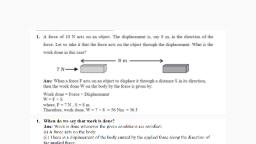
1) Work :, Work is said to be done when a force acts on an object, and the object is displaced in the direction of force., , The work done on an object is the product of the force, applied and the displacement., , Work done = force x displacement, W=FXs, The unit of work is joule (J)., , If F is 1 Newton and displacement is 1 metre then the, work done is 1Nm or 1 joule (J)., , So 1 joule is the amount of work done when a force of |, Newton displaces an object by 1 metre., , Eg :- If a force of 5 N acts on an object is displaced, through 2 m in the direction of force, then work done is, , 5Nx2m=10Nm or 10 J
Page 2 :
The work done by a force may be positive or negative., , The work done by a force is positive if the force and displacement are, in the same direction., , The work done by a force if negative if the force and displacement are, in opposite directions., , The work done by a force is zero if there is no displacement., The work done by a force is zero if the force is perpendicular to the, displacement., , Eg :- When we lift an object the object moves upward in the direction, of force. Here the work done is positive. But there is the force of gravity, acting downward on the object. The work done by the force of gravity, is negative., , Eg :- A porter lifts a luggage of 15 kg from the ground and puts it on, his head 1.5 m above the ground. Calculate the work done by him on, the luggage., , Mass of luggage m= 15 kg, displacement = 1.5 m,, , Acceleration due to gravity = 10 ms:, , Workdone WeFxs = mgxs = 15kgx10 ms: x15m, , =225kgms? =225Nm =225J
Page 3 :
4) Potential energy :, The potential energy of an object is the energy possessed, by the object due to its position or shape., , Eg :- If a rubber band is stretched and then released it, regains its original position. When the rubber band is, stretched, energy is transferred to it and stored as potential, energy., , If we wind the key of a toy car and place it on the ground, it moves. When we wind the key of the car, energy is, transferred to the spring inside and stored as potential, energy., , If we lift an object to a height and release it, it falls down., When the object is lifted energy is transferred to it and, stored as potential energy.
Page 4 :
6) Transformation of energy :The conversion of energy from one form into another, form is called transformation of energy., , When energy is converted from one form into another, the, total energy always remains the same., , Law of conservation of energy :The law of conservation of energy states that energy can, only be converted from one form into another, it can neither, , be created nor destroyed. The total energy before and after, the transformation remains the same., , Eg :- Let an object be allowed to fall freely from a height. At the start the, potential energy is more. As it falls down the potential energy changes, into kinetic energy. The potential energy decreases and the kinetic, energy increases. When the object is about to reach the ground the, kinetic energy is the largest and the potential energy is the least. But the, sum of the potential energy and kinetic energy is the same at all points., So potential energy + kinetic energy = constant. The sum of the potential, energy and kinetic energy is the total mechanical energy.
Page 5 :
2) Energy :The energy of an object is its capacity for doing work., The unit of energy is the same as that of work that is, joule(J)., 1 joule is the energy required to do 1 joule of work., 1000 J = 1 kilo joule (kJ)., There are different forms of energy. They are heat energy, light, , energy, electrical energy, chemical energy, mechanical energy, (potential energy + kinetic energy) etc., , 3) Kinetic energy :The kinetic energy of an object is the energy possessed by the, object due to its motion., , All moving objects possess kinetic energy. A falling coconut,, a speeding car, a flying aircraft, flowing water, blowing wind, a, running athlete etc. possess kinetic energy., The kinetic energy of an object depends upon its speed. An, , object moving faster has more kinetic energy than an object, moving slower.